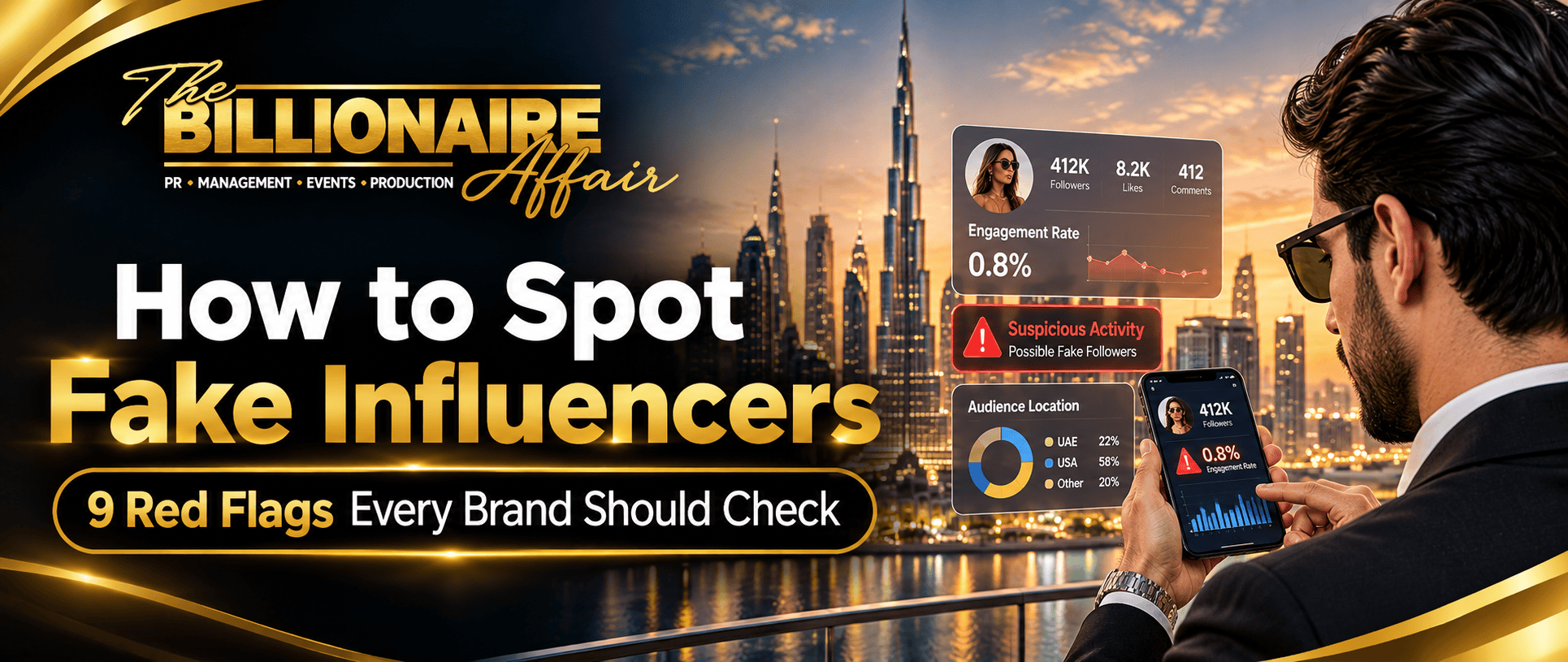
How to Spot Fake Influencers
You find an influencer with 400,000 followers. The photos look great, the niche fits your brand, and the quote seems reasonable. You sign the deal, the post goes live, and then nothing happens. A few likes, no real comments, and zero sales how to spot fake influencers.
It’s a frustrating moment, and it happens more often than most brands admit. Fake influence is a real problem, especially in fast-growing markets like the GCC, where brands are investing heavily in influencer marketing partnerships.
The good news is that fake influencers leave clues. Here’s how to spot fake influencers before you spend a single dirham.
1. Look at engagement, not follower count
Follower count is the easiest number to buy, so it tells you the least. Engagement tells you much more.
As a rough guide, divide likes and comments by followers on recent posts. A very large account with an engagement rate far below 1% deserves a closer look. On the other hand, a small account with extremely high engagement on every post can also be suspicious, especially if the comments look unnatural.
2. Read the comments, not just count them
Real audiences talk like real people. They ask questions, share opinions, tag friends and sometimes disagree.
Be careful when you see:
- Generic comments like “Nice pic!”, “Love this ❤️” or “Great post” repeated on every post
- Strings of emojis with no words
- Comments that have nothing to do with the content
- The same accounts commenting again and again
3. Check for sudden follower spikes
Organic growth is usually steady, with small jumps after a viral post or a collaboration. If an account gains tens of thousands of followers overnight and then stays flat, those followers were most likely purchased.
Platforms are also fighting this. Instagram says that apps generating automated likes, comments and follows go against its Community Guidelines, so accounts that rely on them can see their numbers drop suddenly. Free tools and third-party analytics platforms can show you growth history, and it takes only a few minutes.
4. Inspect the followers themselves
Open the follower list and scroll through a sample. Warning signs include:
- Profiles with no profile picture or no posts
- Usernames made of random numbers and letters
- Accounts following thousands of people but with almost no followers
- A large share of followers from countries that make no sense for the influencer’s audience
If an influencer says they speak to a UAE audience but most of their followers are from somewhere unrelated, ask why. For more on choosing the right creators for the region, see our guide to influencer marketing in the UAE.
5. Compare likes, comments and views
The numbers on a real account tend to move together. Be cautious if you see:
- Thousands of likes but almost no comments
- Strong likes but very low video views or story views
- Reels with huge views but little interaction
Story views are especially useful. A real account usually gets a steady share of its followers viewing stories. A very low number against a big following is a red flag.
6. Review the quality of past brand collaborations
Good influencers have a track record. Look at their previous sponsored posts and ask:
- Did the content feel natural, or like a copy-pasted ad?
- Did the audience react with real interest?
- Do they promote ten unrelated brands in a single month?
- Do they clearly label paid posts? The FTC’s Disclosures 101 for Social Media Influencers explains why influencers must make brand relationships obvious, and creators who ignore this are a risk to your brand.
Too many unrelated promotions often mean the creator will say yes to anything, which weakens trust with their audience.
7. Watch for engagement pods and giveaway growth
Some creators join engagement groups where members like and comment on each other’s posts to trick the algorithm. Others grow mainly through giveaway loops, which attract people who only want free prizes.
Both can inflate numbers without building a real, interested audience. Signs include identical comment patterns, comments arriving within minutes of posting from the same group of accounts, and lots of follow-for-follow behavior.
Be extra careful with creators who use growth apps that ask for login details. Instagram warns that apps offering likes and followers in exchange for your login are likely to misuse the account.
8. Ask for real data
Professional influencers are happy to share proof. Before you sign, ask for:
- Screenshots of audience demographics (age, gender, location)
- Recent reach and impressions
- Past campaign results or case studies
- Media kit with rates and past partners
Hesitation, excuses or screenshots that look edited are worth noting. A confident creator with a real audience has nothing to hide.
9. Trust your instincts, then verify them
Sometimes the profile just feels off. The content is polished but lifeless, the audience doesn’t respond, and the story doesn’t add up. Don’t ignore that feeling. Use it as a reason to dig deeper with the checks above.
Quick Checklist: How to Spot Fake Influencers Before You Hire
- Engagement rate is reasonable for the account size
- Comments are real and relevant
- Follower growth looks steady
- Audience location matches your target market
- Story and video views are consistent with followers
- Past collaborations look authentic
- The creator shares data openly
Why it matters
Working with fake influencers doesn’t only waste money. It can also hurt your brand’s credibility, skew your campaign data and cost you time that you can’t get back. Learning how to spot fake influencers protects both your budget and your brand.
If you’d rather not do this alone, working with an influencer marketing agency in Dubai that checks audience quality, past performance and brand fit for you can save a lot of risk. Contact our team to talk about your next campaign.
FAQ
Can fake followers be completely avoided?
Almost every large account has some bots or inactive followers. The goal is to make sure the majority of the audience is real and relevant to your brand.
What is a good engagement rate?
It varies by platform, niche and account size. Smaller accounts usually have higher rates than very large ones, so compare creators of similar size.
Are micro-influencers safer than big names?
Not automatically, but they often have more engaged, niche audiences. Vet them the same way you would anyone else.